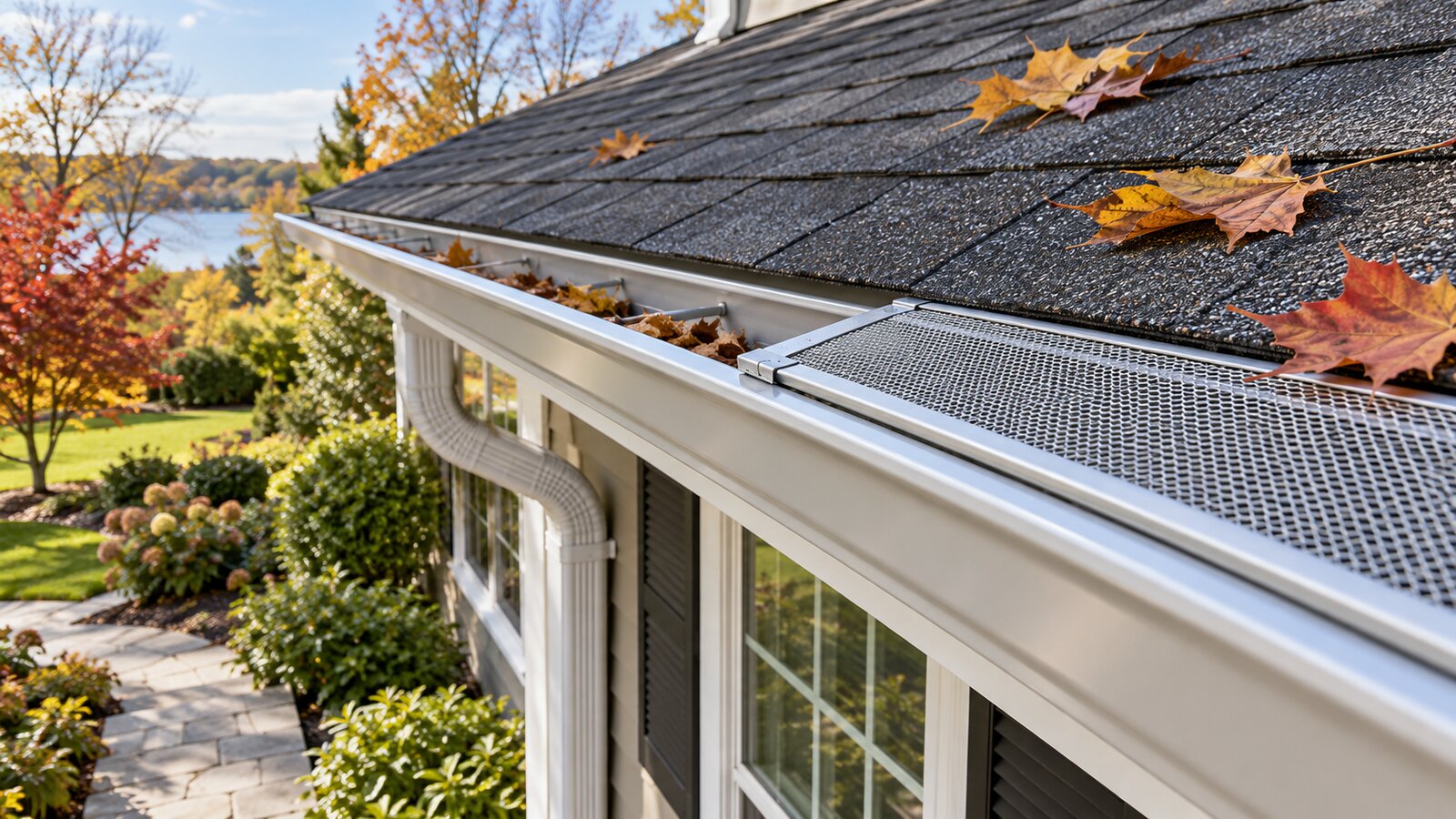
Quick answer: gutter guard installation cost depends on the measured gutter runs, guard design, roof-edge access, existing gutter condition, corners and the cleaning or repair needed before installation. A guard can reduce some debris entering a gutter, but it does not eliminate inspections or make a poorly draining system work. Price the full drainage path, gutter, outlets, downspouts and discharge, before comparing products.
If the gutters are sagging, leaking or undersized for the roof, begin with the gutter replacement planning guide. Adding a screen to a defective trough can conceal the problem and make future cleaning more awkward.
Measure what will actually receive guards
Walk the perimeter from the ground and mark each gutter run on a simple sketch. Note the length along the eave, inside and outside corners, valleys that dump concentrated water, and the number and position of downspouts. Do not substitute the home's floor area for gutter length. Ask an installer to verify the takeoff, roof-edge condition and safe access on site. A home with 140 linear feet of gutters may need guards on all runs or only on tree-facing sections, depending on the maintenance goal and product compatibility.
Keep the measurement worksheet with the quote. The Contractor Quote Comparison Tool helps place each proposed linear footage, preparation item, downspout task and warranty on the same basis.
How much gutter guard length for a 2,000 sq ft two-story house?
Square footage is a poor shortcut for a guard order because it usually describes finished floor space, while guards cover selected eave runs. For example, a hypothetical two-story house with 2,000 sq ft of total floor area could have a 1,000 sq ft rectangular footprint measuring 25 by 40 feet. Its footprint perimeter is 2 × (25 + 40) = 130 linear feet, but that is not automatically the gutter quantity. A simple gable roof might have gutters only along the two 40-foot eaves, or 80 feet; a hip roof might have a different layout. A porch could add a separate 20-foot low run. Measure each actual run rather than multiplying house area by a universal factor.
For a two-story quote, split the takeoff by access. If the hypothetical project has 80 upper-story feet and 20 porch feet, request separate installed rates for each height: 80 × upper-story rate + 20 × porch rate + cleaning + repairs + any documented access equipment. Ask whether corners, roof valleys, downspout outlets and minimum crew charges are included. This produces a usable local estimate without pretending that a national per-foot rate fits every house. The roofer should verify the lengths and attachment method before ordering.
Low, typical and high scope
| Scenario | What it assumes | What could change it |
|---|---|---|
| Lower scope | Sound, accessible one-story gutters; straightforward runs; cleaning and compatible guards | Hidden loose hangers or blocked outlets |
| Typical scope | Several corners, varied roof edges, some downspout flushing and minor gutter adjustments | Fascia repair, steep access or valley overflow |
| Higher scope | Multiple stories, complex roof, extensive cleaning, gutter or fascia repairs and drainage corrections | Lift or staging, new downspouts or soil-drainage work |
These are scope categories, not price claims. A homeowner should ask for a written price per run or a measured total with clear included work. Materials, installation, cleaning, gutter repairs and disposal should be identified separately. Model uncertain repair as a reserve with the Project Contingency Calculator, rather than treating the lowest quote as the full budget.
Guard styles and the maintenance tradeoff
Common approaches include perforated metal covers, fine mesh, solid surface designs and inserted screens. Openings, edge details, fastening and cleaning access differ. No single style reliably handles every combination of pine needles, small seeds, leaves, roof grit and heavy runoff. Ask the vendor to demonstrate how the specific product will be cleaned and how a blocked gutter or outlet can be accessed without damaging the guard or roof.
Fine mesh may catch smaller debris at the top, which means that material can accumulate on the mesh and still require removal. A larger opening can let smaller debris pass into the trough. A solid cover depends on water following its intended path; concentrated runoff at a valley or a steep roof may need a specific detail. Inspect the system after a real rain event before assuming the demonstration under a hose proves performance.
Worked example: normalize two hypothetical proposals
Suppose a homeowner measures 160 linear feet. Proposal A quotes $2,800 for guards and installation but excludes $250 of pre-installation cleaning, $180 of downspout clearing and a $120 loose-hanger repair. Proposal B quotes $3,180 and includes cleaning, outlet clearing and the documented hanger repair. If both use a compatible product and comparable coverage, the normalized known total for A is $2,800 + $250 + $180 + $120 = $3,350, while B remains $3,180. These dollar amounts illustrate arithmetic only; they are not national or local market prices.
Next compare the products, workmanship, cleaning method and warranty exclusions. A less expensive complete quote can still be a poor fit if it leaves an overflowing valley or discharges beside the foundation. Conversely, an expensive product may not justify replacing sound gutters. Ask for photographs of the cleaned trough and outlet before the guard covers them.
Check the roof edge and drainage before installation
Inspect from a safe location for sagging runs, standing water, separated seams, missing end caps, loose hangers, damaged fascia and roof-edge flashing that may be disturbed by the guard. Fastening methods should not interfere with the roof covering or manufacturer requirements. When coordinating with a roof project, the roof replacement checklist helps define drip edge, fascia and gutter responsibility between trades.
Trace the water after it exits the downspout. The U.S. Environmental Protection Agency advises maintaining roof gutters and directing ground slope away from a building's foundation. Its downspout guidance also notes that redirection needs safe discharge and maintenance. Guards do not fix a disconnected downspout, a blocked underground line or an area where water collects against the house.
Access, regional conditions and permits
Installation on a tall or steep house can require additional staging and qualified workers. The Occupational Safety and Health Administration's ladder resources explain workplace ladder hazards; homeowners should avoid treating a difficult second-story roof edge as a casual do-it-yourself job. Request that the contractor describe access equipment and protection of landscaping, windows and the roof edge.
Regions with leaf fall, conifer needles, ice, intense seasonal rain or wildfire exposure present different maintenance questions. Snow and ice can accumulate above or on guards; a guard is not an ice-dam remedy. In fire-prone areas, discuss local ember and vegetation requirements with the authority having jurisdiction rather than relying on a generic product claim. Permit rules for attaching guards, changing gutters, connecting drainage or altering an historic façade vary locally; confirm with the building department and any HOA.
Inclusions, exclusions and warranty questions
A complete proposal should state the measured lengths, product and finish, attachment method, removal of old guards, gutter cleaning, outlet and downspout testing, minor repairs, debris disposal, access, cleanup and workmanship warranty. Ask whether fascia replacement, gutter re-pitching, new downspouts, underground drain cleaning, roof repairs and permit fees are excluded. If an exclusion is likely, obtain a separate line item before accepting a total.
Read a clog warranty carefully. Determine whether it covers material failure, installation defects, routine cleaning, overflow from roof valleys or service calls. Request maintenance instructions that preserve warranty coverage. A practical post-installation check includes photos of each run and an inspection during the next substantial rain. Record overflow locations and ask the installer to investigate rather than assuming all splashing is normal.
Decision checklist
- Confirm gutters are sound and pitched to functioning outlets.
- Sketch measured runs and mark concentrated roof runoff.
- Agree on a product compatible with the gutter and roof edge.
- Require cleaning and outlet testing before covering the trough.
- Separate repairs, access and drainage changes from guard installation.
- Compare written warranties and maintenance duties.
- Verify local permit or HOA requirements.
- Inspect after rain and retain photos and invoice.
If the roof is also being replaced, enter the larger project in the Roof Replacement Calculator while keeping gutter guards as a separate quoted line. This avoids counting the same setup or gutter replacement work twice.
Frequently asked questions
Do gutter guards eliminate cleaning?
No. Debris can collect on the guard, at corners and at outlets. The gutter and downspouts still need inspection and maintenance according to the site and product.
Should guards be installed on damaged gutters?
Repair or replace loose, leaking or poorly pitched gutters first. A guard does not correct drainage geometry or failed fascia.
How is the installation quantity measured?
Measure the actual eave runs receiving guards in linear feet, then note corners, roof valleys, stories and access separately. Have the installer verify the takeoff.
Are guards worth it for every home?
The answer depends on debris, safe cleaning access, maintenance cost and product suitability. Compare the complete installed and future maintenance scope.
Does installing guards require a permit?
Rules vary by jurisdiction, especially if gutters or drainage are being changed or a protected façade is involved. Confirm locally before work.
What affects gutter guard installation cost on a two-story house?
Measured upper-story gutter length, access equipment, roof pitch, corners, product attachment, cleaning and repairs all affect the complete installed scope. Request upper and lower run quantities separately.
How many feet of gutter guards does a 2,000 sq ft house need?
There is no reliable answer from floor area alone. Measure the eaves that actually have gutters, then subtract any runs that will not receive guards and include separate porch or garage gutters.