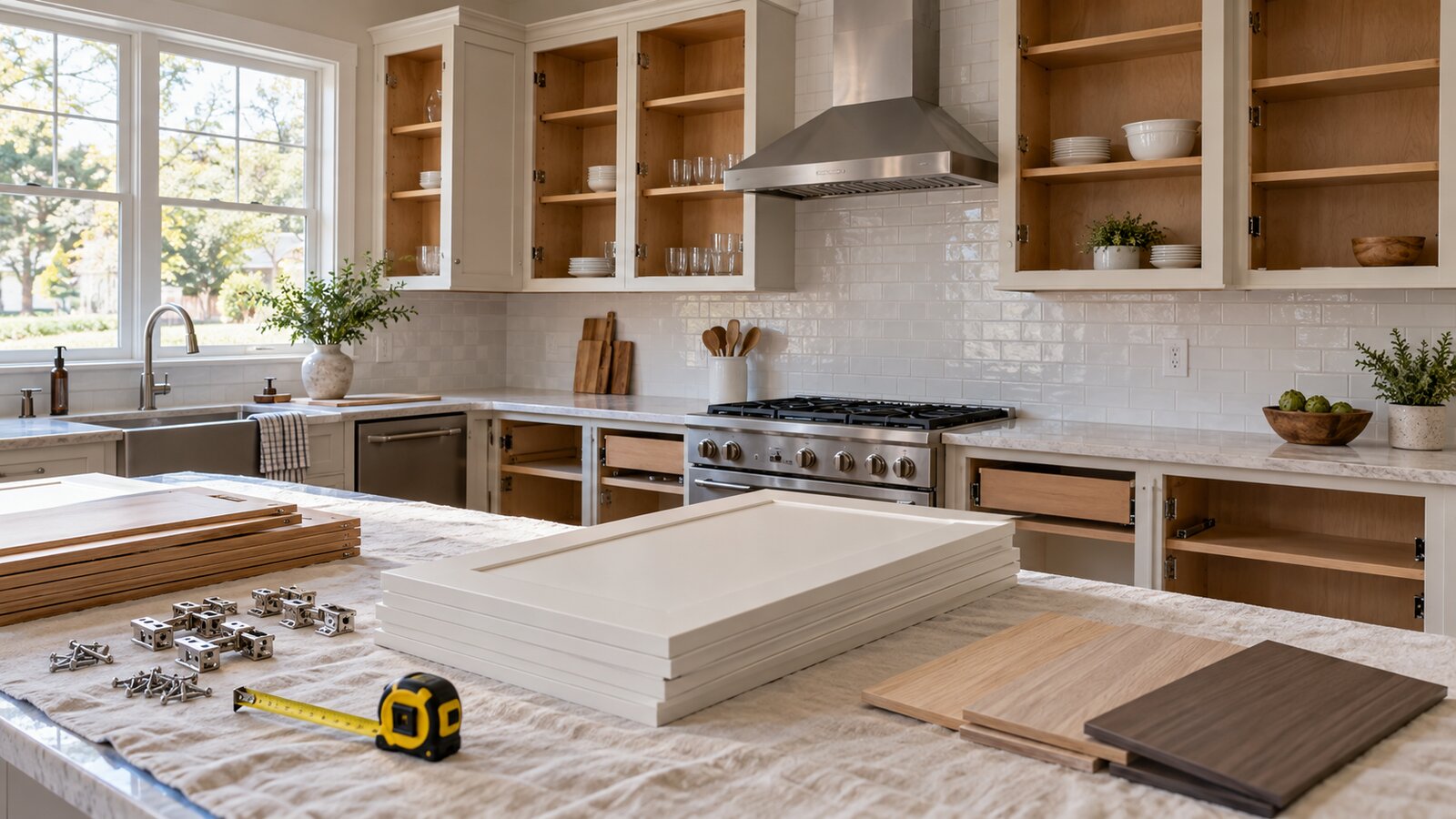
Quick answer: kitchen cabinet refacing cost depends on how many doors and drawer fronts are replaced, the exposed cabinet-box surfaces being finished, material and hardware choices, repairs, site preparation and labor. Refacing usually keeps sound cabinet boxes and the existing layout while changing their visible surfaces. It is a different scope from painting existing doors or replacing entire cabinets. The right budget begins with a door-and-drawer count and an inspection of the boxes.
Refacing is most useful when the cabinet layout works and the boxes are square, secure and dry. If the kitchen needs a new layout, deeper storage, appliance changes or damaged boxes, compare a full project in the Kitchen Remodel Cost Guide before assuming a new exterior will solve the underlying problem.
What is included in refacing?
A typical refacing plan replaces doors and drawer fronts, applies matching veneer or another finish to exposed face frames, end panels, fillers and visible box surfaces, then installs hinges and pulls. The cabinet interiors and box footprint usually remain. Confirm whether the proposal also addresses toe kicks, crown, light rails, open shelves, inside edges, island panels and glass doors. Those surfaces can become conspicuous when omitted.
Refacing should not be confused with refinishing. Refinishing prepares and coats the existing doors and boxes, while refacing supplies new door and drawer faces. Resurfacing materials, door style, finish durability and hinge type vary. Ask for a sample of the actual door and edge treatment, not just a small color chip, because the finished appearance depends on how new faces meet old boxes.
Low, typical and high planning logic
| Scope | What stays or changes | Key allowance |
|---|---|---|
| Lower scope | Sound boxes, standard door sizes, limited exposed ends, simple finish and existing layout | Basic hardware and minor adjustment |
| Typical scope | All doors and fronts replaced; face frames, sides and fillers finished; hinges and pulls updated | Small box repairs and matching trim |
| Higher scope | Many custom sizes, decorative panels, specialty storage, damaged boxes or countertop coordination | Carpentry and adjacent finish work |
These are planning categories, not market-price estimates. Use verified local prices in the Kitchen Remodel Cost Calculator, then replace broad assumptions with a detailed refacing proposal. Keep any countertop, backsplash, appliance or flooring work separate so the refacing line stays comparable.
Count the work, not just the kitchen area
Two kitchens with the same floor area can have very different door and drawer counts. Make an elevation sketch for each wall. Number every door, drawer front, finished end panel and special opening. Note approximate dimensions, hinge direction, corner cabinets and whether existing shelves and interiors will remain. A small kitchen with many drawers and glass fronts can require more fabrication than a larger kitchen with simple paired doors.
Ask the installer to check whether hinges will fit the existing boxes, whether a new overlay changes clearances near walls and appliances, and whether drawers operate correctly before new fronts are attached. A new face does not repair a failing drawer slide or water-damaged base. Photograph the cabinet-box condition during the survey.
Cabinet refacing scope calculator
Use this calculator after you have a written proposal. It does not invent a local price. It counts the visible components, adds required exclusions back to the quoted total, and shows an allocated total per new door or drawer front so two bids can be checked on the same known scope.
Formula: new faces = doors + drawer fronts. Normalized known total = written quote + required excluded hardware + known excluded repairs. Allocated total per new face = normalized known total ÷ new faces. Keep exposed panels visible as a separate count; do not pretend the allocation is a transferable market rate or a door-only price.
Save the counts, inclusions and exclusions in the free project-cost planning workbook, then return to the quote comparison tool when another proposal arrives. The workbook downloads without marketing consent; email delivery and ongoing tips are separate choices.
Worked example: compare refacing and replacement scopes
Consider an illustrative kitchen with 20 cabinet doors, 8 drawer fronts and 5 exposed end or side panels. Proposal A is a $9,600 refacing quote that includes all 28 new faces, matching exposed surfaces, hinges, installation and cleanup, but excludes $600 of pull hardware and a $450 repair to a loose sink base. Its normalized known total is $10,650. Proposal B is a $12,400 cabinet replacement quote including new boxes and doors but excluding $1,100 of countertop removal and reset and $750 of floor patching. Its normalized known total is $14,250.
These dollar figures are hypothetical arithmetic, not current prices. Proposal B includes a different product and potentially different service life, storage and layout options, so the totals alone do not settle the decision. A homeowner whose boxes are sound and layout is useful may favor the narrower scope. A homeowner with damaged boxes or a planned layout change should compare replacement on its own merits. Enter line items and exclusions in the Contractor Quote Comparison Tool.
How to estimate refacing for 20 cabinet doors and 8 drawers
The example above has 20 doors and 8 drawer fronts, but dividing the total quote by 28 creates a misleading “price per door.” The $10,650 normalized scope also includes five exposed panels, hinges, installation, cleanup, pulls and the sink-base repair. Its arithmetic average is about $380 per opening ($10,650 ÷ 28), yet that is an allocated project average, not a door fabrication price or a transferable market rate.
To compare another 20-door kitchen, ask for a worksheet with 20 × door unit cost + 8 × drawer-front unit cost + 5 × panel treatment + frame and edge finishing + hinges and pulls + installation + known repairs. If a contractor bundles those items, request the included counts and specifications in writing even if individual unit prices are unavailable. The useful comparison is a complete, like-for-like scope: one proposal may include soft-close hinges and finished island ends while another stops at doors. Kitchen floor area alone cannot resolve that difference.
Inspect the boxes before choosing refacing
Look for swollen particleboard around the sink or dishwasher, loose wall mounting, racked frames, bowed shelves, delaminated side panels and recurring moisture. Check that drawers glide and doors close without rubbing. If several boxes need rebuilding, the cost and disruption of repairs can narrow the gap with replacement. Obtain a separate repair scope rather than allowing a finish crew to hide damaged material behind veneer.
Cabinet height and location matter too. Refacing does not move the range, make an old refrigerator opening wider, add a pantry or change the path between sink and cooktop. If a design depends on those changes, price it as a remodel. The Labor and Material Split Calculator can help expose whether a proposal is driven by custom fabrication, installation time or both.
Finish, hardware and construction details
Specify the door core and finish, veneer or panel material, edge banding, hinge model, soft-close treatment, pull allowance, trim profile and how seams and corners will be finished. Ask whether the installer will remove doors off site, finish boxes in place, or use factory-finished parts. Record any color variation between new doors and existing cabinet interiors so expectations are realistic.
Countertops can complicate the project. If existing counters remain, workers must protect them and work around fixed overhangs. A new sink, countertop thickness or backsplash can create additional trades and alter the sequence. Appliances may need to be moved temporarily. Ask who disconnects and reconnects them and whether plumbing or electrical work is excluded.
Regional, permit and lead-paint caveats
Fabrication lead times, installer availability, building rules and freight vary by region. A condominium may require work-hour limits, elevator protection and contractor documentation. Purely cosmetic refacing with unchanged utilities may be treated differently from work that moves plumbing, adds circuits or changes structural elements; the local building department determines applicable permits.
For pre-1978 housing, disturbing painted surfaces can trigger lead-safe work requirements for covered renovations. The U.S. Environmental Protection Agency's Renovation, Repair and Painting program explains contractor certification and containment rules. Ask how the existing finish will be evaluated before sanding, scraping or demolition; do not assume a cabinet job is exempt. EPA also recommends isolating remodeling dust and ventilating work areas to protect indoor air quality.
Contingency and exclusions
Keep uncertain sink-base repairs, hidden wall damage and countertop or floor corrections out of the fixed finish allowance. Create a documented reserve with the Project Contingency Calculator. A reserve should be based on the condition survey and remaining unknowns, not an arbitrary universal percentage. Require photos and a written change order before additional repairs proceed.
Common exclusions include box replacement, new drawer hardware, interior organizers, countertop removal, backsplash repair, paint outside cabinets, appliance work, plumbing, electrical, flooring transitions and lead-related testing or containment. A proposal may also exclude permit fees or delivery. Clarify who handles defective doors and the process for color or fit corrections after installation.
Homeowner quote checklist
- Count doors, drawer fronts, exposed ends and decorative panels.
- Inspect boxes, mounting, slides and moisture damage.
- Approve door style, finish, edge and hardware samples.
- Define removal, site protection, fabrication and installation.
- Separate countertop, backsplash, appliance and utility work.
- Confirm lead-safe practices and local permit requirements.
- Document exclusions, repair unit prices and change orders.
- Inspect alignment, operation and finish before final payment.
For a full-room budget that includes more than cabinetry, revisit the worked home-project budget examples and keep known selections separate from concealed-condition reserves.
Frequently asked questions
Is refacing cheaper than new cabinets?
It can involve a narrower scope because sound boxes remain, but the answer depends on door count, finish, repairs and what a replacement proposal includes. Compare complete written scopes.
Can damaged cabinet boxes be refaced?
Minor repairs may be possible, but swollen, loose or structurally unsound boxes need evaluation. New doors do not restore a failing cabinet structure.
Does refacing change the kitchen layout?
Usually no. It changes visible cabinet surfaces while boxes and appliance locations remain. Moving utilities or cabinets is a broader remodel.
Do I need a permit to reface cabinets?
Rules vary locally. Cosmetic work without utility or structural changes may differ from plumbing, electrical or layout changes. Ask the local building department.
What should the warranty cover?
Ask separately about door and finish defects, veneer adhesion, hardware, installation alignment and any exclusions for moisture or misuse.
What does refacing cost for 20 doors and 8 drawers?
There is no dependable national total from the face count alone. Use the scope calculator with your written quote: add required excluded hardware and known repairs, divide the matched total by the 28 new faces only as an allocation, and keep exposed panels and trim as separate scope items. Compare the same inclusions across bids.