Quick answer: patio concrete in cubic yards = length in feet × width in feet × slab thickness in inches ÷ 324. A 12 × 16-foot patio at a specified four-inch thickness contains exactly 64 cubic feet, or 2.3704 cubic yards, before extra shapes or an order allowance. Enter those dimensions in the concrete volume and bag calculator; use the measured slab thickness, not the total excavation depth.
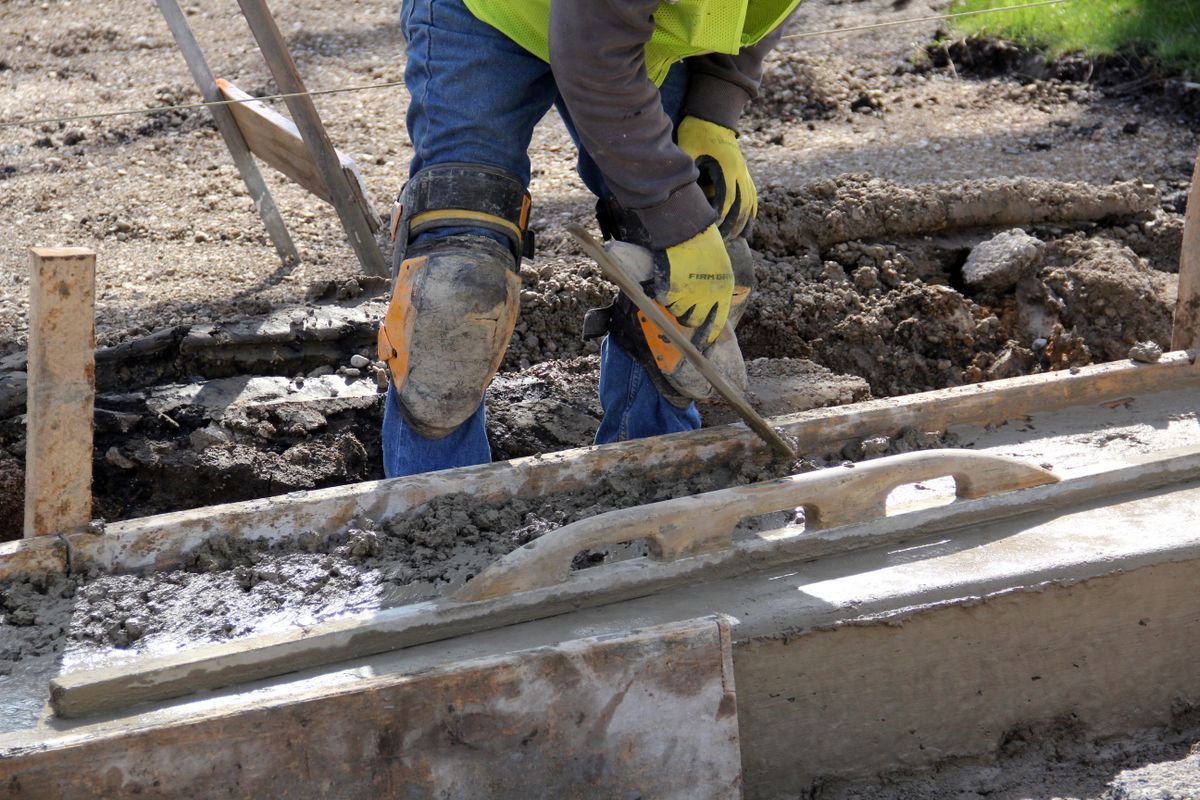
Measure the concrete space inside the forms
Record the inside length and width after the forms are set. A rough sketch or an outside lumber dimension can overstate the pour. Check the distance from the prepared base to the intended finished surface at several locations. Concrete thickness is the gap between those two surfaces; it is not the height of the form board or the depth of all excavation.
Keep the aggregate base on a separate material line. A hypothetical four-inch base beneath four inches of concrete requires two different quantity calculations. It does not mean ordering eight inches of concrete. QUIKRETE's concrete patio project instructions distinguish preparation, the gravel subbase and form layout. Have the installer confirm the appropriate section, drainage and joint plan for your site before calculating an order.
Worked example: 12 × 16 ft at 4 inches
The divisor 324 combines 12 inches per foot with 27 cubic feet per cubic yard. Calculate with the exact four-twelfths thickness rather than rounding it to 0.333 feet at the first step.
| Quantity step | Calculation | Result |
|---|---|---|
| Slab area | 12 × 16 | 192 sq ft |
| Concrete volume | 192 × 4 ÷ 12 | 64 cu ft |
| Geometric cubic yards | 64 ÷ 27 | 2.3704 yd³ |
| Illustrative 10% allowance | 64 × 1.10 ÷ 27 | 2.6074 yd³ |
The final row is a chosen planning scenario, not a universal recommendation. If a supplier accepts quarter-yard increments and directs you to round upward, 2.6074 becomes a 2.75-yard order under that rule. Confirm its actual increment, minimum load and applicable fees. Keep the unrounded quantity until the final ordering step.
Calculate a patio with two rectangles
For an L-shaped patio, divide the footprint into non-overlapping rectangles. Suppose the 12 × 16-foot main section has a separate 6 × 8-foot extension at the same four-inch thickness. The extension adds 6 × 8 × 4 ÷ 12 = 16 cubic feet. Together they contain 80 cubic feet, or 2.9630 cubic yards, before allowance.
If your two measurements overlap, subtract that overlap once. Draw the shared boundary and label each section on the sketch. If the extension uses a different thickness, calculate its volume separately instead of applying one thickness to the combined area. Curved borders can be estimated as measured small sections; do not use the full bounding rectangle where a large portion will remain unpoured.
Add steps and thickened portions only once
A freestanding solid rectangular step measuring 6 feet wide, 2 feet deep and 6 inches high contains 6 × 2 × 6 ÷ 12 = 6 cubic feet, or 0.2222 cubic yards. That calculation applies only if the specified step is actually solid and its full volume lies outside the slab already counted. A hollow, filled or overlapping step requires the actual concrete cross-section.
With that separate solid step, the two-rectangle example totals 80 + 6 = 86 cubic feet, or 3.1852 cubic yards. A chosen 10% allowance brings it to 3.5037 cubic yards. Under the hypothetical quarter-yard upward-rounding rule, that becomes 3.75 yards, not 3.50. The small difference shows why an order should not be based on prematurely rounded display values.
For a thickened edge, count the additional depth below the slab already included, and avoid counting corner overlaps twice. The extra-concrete guide for measured edges and low spots supplies a separate geometry method. A percentage cannot replace concrete you already know the drawing requires.
Translate the base patio into bags
Bag count = required cubic feet ÷ the exact product's mixed yield, rounded upward to a whole bag. For the original 64-cubic-foot rectangle with an illustrative 10% allowance, required mixed volume is 70.4 cubic feet. QUIKRETE Concrete Mix No. 1101 lists approximately 0.60 cubic foot per 80-pound bag and 0.45 per 60-pound bag in its product data sheet.
| Specific product example | Calculation | Whole bags |
|---|---|---|
| 80-lb No. 1101, 0.60 cu ft yield | 70.4 ÷ 0.60 = 117.3333 | 118 |
| 60-lb No. 1101, 0.45 cu ft yield | 70.4 ÷ 0.45 = 156.4444 | 157 |
These are product-specific arithmetic examples, not a recommendation to hand-mix this entire patio. Other mixes and package sizes can yield different volumes. Check the current bag label, placement method, mixing capacity and crew plan. Use the ready-mix versus bagged concrete comparison to consider delivery access, working sequence and labor alongside quantity.
Keep design and ordering decisions separate
A quantity table cannot choose a safe patio thickness, reinforcement, slope or support condition. Climate, frost exposure, soil, drainage, loading and local requirements can change the design and mix specification. A patio intended to carry a hot tub, masonry feature or future enclosure needs its loads reviewed rather than treating ordinary foot traffic as the only use.
Confirm whether local approvals, setbacks or drainage rules apply. Arrange safe access and a washout plan with the supplier and installer. Material quantity excludes excavation, base placement, reinforcement, forms, finishing, joints, curing, pumping, demolition and disposal unless the proposal expressly includes them. There is no single national per-yard price that establishes a complete installed patio budget.
Save an order record before calling the supplier
Use the free project-cost planning workbook to record the slab dimensions, approved thickness, each added shape, measured extra depth, chosen allowance and supplier rounding rule. Keep the geometric quantity and the final proposed order on different lines so the next person can check the arithmetic.
Ask the supplier to confirm the specified mix, delivery quantity, unloading access, minimum-load or short-load charges and waiting-time terms. Recalculate after any change to the form dimensions or slab section. Comparing two quotes is useful only when both cover the same concrete quantity and placement scope.
Frequently asked questions
How much concrete is in a 12 × 16-foot patio at four inches?
The geometric volume is 64 cubic feet, or 2.3704 cubic yards, before separately measured additions, a chosen allowance or supplier rounding.
Does four inches of gravel base count as concrete?
No. Calculate the aggregate base and concrete slab as separate materials using each layer's specified thickness.
How do I count a step without counting the slab twice?
Calculate the actual solid concrete shape and add only volume that is outside the slab already counted. Do not assume a filled or hollow step is solid concrete.
Does this guide recommend a universal waste percentage?
No. Measure known extra shapes first, then agree on a separate allowance for remaining uncertainty and handling. Confirm the supplier's final ordering increment.